French 3 Online Class: One-on-One vs. Semi-Private Learning – Which Format Is Right for You?

For intermediate learners ready to push toward advanced fluency synchronous live classes deliver the strongest results, thanks to real-time instructor feedback and consistent peer interaction, but asynchronous options can work well if your schedule simply won’t accommodate fixed meeting times. We’ve evaluated both formats across the dimensions that matter most at the intermediate level: speaking practice, error correction speed, cultural immersion, and schedule flexibility. The right choice depends less on quality than on how you learn best and what your daily routine can realistically support.
French 3 sits at a pivotal stage in your language journey. You’ve mastered the basics, navigated present and past tenses, and built a working vocabulary. Now the goal shifts to nuance: expressing subjunctive moods, understanding regional idioms, and participating in conversations that move beyond transactional exchanges. This is where instructional format starts to matter. A recorded video can teach you the passé simple, but only live dialogue reveals whether you’re using it naturally or sounding like a textbook.
The good news? Online learning in 2026 offers genuinely effective paths in both directions. Synchronous platforms now feature breakout rooms, live pronunciation coaching, and cultural discussions that mirror in-person seminars. Asynchronous courses have evolved far beyond static PDFs, incorporating AI-driven speech recognition, discussion boards moderated by native speakers, and adaptive lesson paths that adjust to your progress. The question isn’t which format is better in the abstract. It’s which one matches your learning style, your weekly commitments, and the specific skills you need to strengthen as you move toward confident, nuanced French.
At-a-Glance: One-on-One vs. Semi-Private French 3 Classes
We tested both one-on-one and semi-private French 3 classes to understand which format delivers the best results for different learners. Here’s what you need to know at a glance:
| Feature | One-on-One Format | Semi-Private Format |
|---|---|---|
| Class Size | You and your instructor | 2-4 students per class |
| Personalization | Fully customized to your goals | Balanced between group and individual needs |
| Typical Cost | Premium pricing | 30-50% more affordable |
| Interaction Style | Intensive teacher-student exchange | Teacher guidance plus peer conversation |
| Best For | Targeted skill gaps, professional needs, flexible scheduling | Collaborative learning, budget-conscious learners, conversational practice |
Both formats deliver strong intermediate French instruction, but they serve distinct learning preferences. One-on-one classes give you undivided attention and curriculum built around your specific challenges, whether you’re preparing for a certification exam or need to master business French quickly. Semi-private sessions create a shared learning environment where you practice with peers facing similar intermediate hurdles, which often makes speaking practice feel less intimidating while keeping costs manageable.
What Each Learning Format Offers
One-on-One French 3 Instruction

One-on-one French 3 instruction delivers a completely individualized learning experience where you work exclusively with a dedicated teacher throughout each session. This private format means every minute of class time focuses entirely on your specific needs, whether that’s untangling subjunctive mood complexities, refining your pronunciation of challenging sounds, or building vocabulary for your particular professional field.
The exclusive attention allows your instructor to spot patterns in your errors immediately and adjust explanations on the fly. If you consistently struggle with relative pronouns, your teacher can pivot the lesson to address that gap before moving forward. This real-time responsiveness makes learning faster and more efficient than following a predetermined group curriculum that might not match your exact starting point or learning pace.
Customization extends beyond grammar and vocabulary. We’ve observed students shape their one-on-one classes around specific goals: preparing for certification exams, developing business French for workplace presentations, or exploring Francophone literature from Quebec or West Africa. Your teacher tailors reading materials, conversation topics, and practice exercises to what matters most to you rather than balancing multiple students’ interests.
Scheduling flexibility stands out as another significant advantage. Private lessons typically accommodate your availability with easier rescheduling when unexpected conflicts arise. You’re not coordinating around other students’ calendars, which proves invaluable for professionals juggling demanding work schedules or parents managing family commitments.
The intensive teacher-student dynamic creates a focused learning environment where you can’t fade into the background. Every question gets answered, every pronunciation attempt receives immediate correction, and your teacher’s full expertise centers on accelerating your progress through intermediate French.
Semi-Private French 3 Instruction
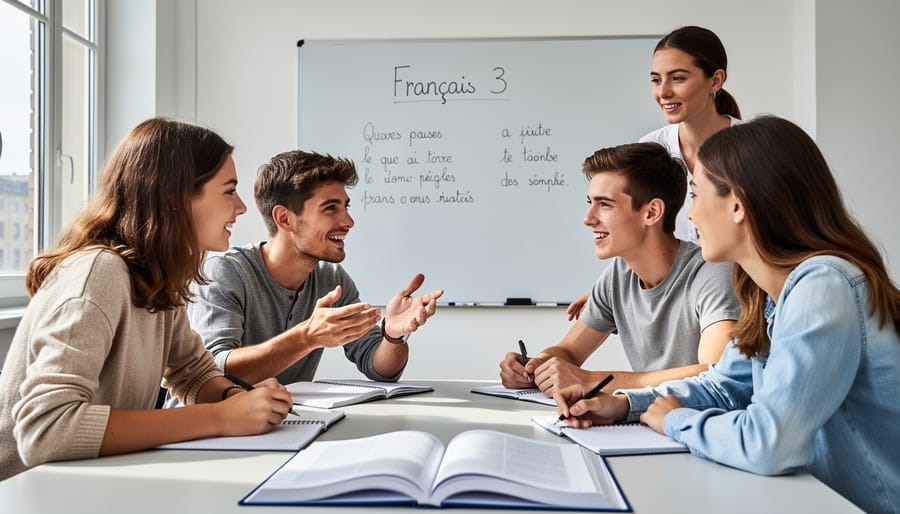
Semi-private French 3 classes bring together a small group, usually two to four students, who share similar language goals and proficiency levels. This format creates a shared learning environment where you’ll work alongside peers navigating the same intermediate challenges, from mastering the subjunctive mood to expanding conversational fluency.
In our experience with semi-private two-on-one lessons and small-group settings, instructors still tailor activities to individual needs while fostering group dynamics. You’ll receive personalized feedback during exercises, but you’ll also benefit from observing how classmates tackle grammar points or pronunciation. This peer exposure often reveals alternative approaches to problems you’re struggling with.
The collaborative aspect stands out: role-playing conversations with fellow learners mirrors real-world interactions more closely than solo practice. One student might play a restaurant server while another orders in French, creating authentic dialogue scenarios. You’ll catch each other’s mistakes, celebrate progress together, and build confidence through shared vulnerability, everyone’s making errors and learning from them.
Teachers balance individual attention with group momentum, circulating during pair work to correct pronunciation or clarify confusion, then bringing everyone together for cultural discussions or grammar explanations. The format works particularly well for learners who thrive on social interaction and find motivation in collective progress. You’re not competing; you’re advancing together, which can ease the self-consciousness that sometimes holds intermediate learners back from speaking freely.
Comparing the Formats: What Matters Most
Personalization and Learning Pace
One-on-one instruction adapts completely to your pace. If you’re struggling with subjunctive conjugations, your teacher dedicates entire lessons to that challenge without moving forward until you’re confident. We found this format particularly effective for learners with uneven skill development, perhaps your reading comprehension is strong but pronunciation lags behind. The teacher reshapes each session based on your progress, spending extra time on verb tenses if grammar trips you up or focusing heavily on oral practice if speaking feels awkward.
Semi-private classes follow a shared curriculum that progresses at a moderate pace suited to the group. While instructors adjust somewhat to collective needs, they can’t pause for days on one person’s grammar confusion without affecting others. That said, the format works well for learners whose skills develop evenly across listening, speaking, reading, and writing. You’ll encounter different learning style approaches from classmates, which can actually broaden your perspective on tackling intermediate challenges.
Choosing the right program depends on whether you need curriculum flexibility or thrive within structured group progression. Learners with specific professional vocabulary needs or unusual scheduling constraints benefit from one-on-one customization, while those progressing steadily often find semi-private pacing perfectly adequate.
Speaking Practice and Interaction
In one-on-one French 3 classes, conversation practice centers entirely on you. Every exchange happens directly with your instructor, creating sustained dialogue where you can’t fade into the background. We found this format maximizes speaking time and allows immediate correction of pronunciation errors, verb conjugations, and syntax issues as they occur. Your teacher adjusts conversational complexity on the fly, pushing you slightly beyond your comfort zone without overwhelming you.
Semi-private classes introduce peer-to-peer dialogue that mirrors real-world conversation more closely. You practice with classmates whose French proficiency varies slightly, exposing you to different accents, speaking speeds, and vocabulary choices. This format builds conversational agility since you negotiate meaning, ask clarification questions, and respond to unexpected phrasing. During our sessions, we noticed students naturally adopted phrases and expressions from each other, enriching everyone’s vocabulary organically.
The feedback rhythm differs noticeably. One-on-one instruction delivers constant, detailed correction. Semi-private settings require instructors to balance correction with conversation flow, sometimes addressing errors after exchanges rather than interrupting them. Both formats integrate interactive tools for pronunciation practice and role-play scenarios, but one-on-one classes typically devote more minutes per lesson to direct speaking.
Cost and Value Considerations
When comparing costs between one-on-one and semi-private French 3 classes, you’ll typically find semi-private instruction priced 30-50% lower than private lessons. While one-on-one sessions might range from $40-80 per hour depending on instructor credentials and program reputation, semi-private classes often fall between $25-45 per hour per student.
Several factors drive these price variations beyond format alone. Instructor qualifications matter significantly, teachers with advanced degrees, specialized certifications in French pedagogy, or extensive immersion experience command higher rates. Program comprehensiveness also affects cost: platforms offering cultural enrichment activities, supplementary materials, and flexible scheduling tools typically charge more than bare-bones conversation practice.
Assessing value requires aligning cost with your specific goals rather than choosing the cheapest option. If you need targeted grammar remediation or profession-specific vocabulary for a job promotion, the higher cost of one-on-one instruction often delivers faster, more measurable progress. Conversely, if your priority is maintaining conversational fluency and building cultural understanding without tight deadlines, semi-private classes offer excellent value through peer dialogue and shared cultural exploration at a more accessible price point.
Consider your learning timeline and budget realistically. Intensive private instruction accelerates progress but requires sustained financial commitment, while semi-private formats make consistent, longer-term study more financially sustainable for many learners.
Schedule Flexibility
One-on-one classes offer maximum scheduling flexibility since you’re coordinating with a single instructor rather than aligning multiple students’ calendars. We found private lessons accommodate last-minute changes more easily, most tutors allow rescheduling with 24-48 hours’ notice without penalty, particularly helpful for professionals managing unpredictable work demands or students juggling exam periods.
Semi-private classes operate on fixed schedules that work for the entire small group, making spontaneous changes more complicated. While this structure creates valuable routine and accountability, rescheduling typically requires coordination among all participants, and some programs don’t permit individual session changes. However, the set schedule can actually benefit learners who thrive on consistency and need that external commitment to maintain progress.
For shift workers, frequent travelers, or anyone with irregular schedules, one-on-one proves notably more adaptable. Semi-private suits those with predictable availability who value the discipline of standing appointments that anchor their learning routine into a specific weekly time slot.
Motivation and Accountability
In semi-private French 3 classes, we’ve observed that peer presence creates a natural accountability structure. Knowing classmates expect you to show up prepared encourages consistent homework completion and active participation. The friendly competition, whether it’s mastering conditional tenses faster or nailing pronunciation, adds positive pressure that keeps intermediate learners engaged between sessions. Seeing peers tackle similar challenges normalizes struggle and builds resilience when grammar gets complicated.
One-on-one lessons offer a different motivational dynamic: focused intensity. There’s nowhere to hide when it’s just you and your instructor, which can be powerfully motivating for self-directed learners who thrive on direct feedback. Every minute centers on your progress, making it easier to spot improvement quickly. However, this format demands higher self-motivation since you lack the external push of peer expectations.
The accountability sweet spot depends on your personality. If you’re energized by group dynamics and benefit from external motivation, semi-private classes provide that collaborative momentum. If direct responsibility to an instructor drives you more effectively than peer influence, one-on-one instruction delivers sharper accountability through its undiluted focus on your performance.
Cultural Immersion and Real-World Practice
We’ve found that cultural immersion manifests differently across formats, each offering distinct pathways to authentic French communication. One-on-one classes excel at deep cultural exploration tailored to your specific interests, whether Québécois expressions, French business etiquette, or regional idioms relevant to your goals. Your instructor adapts cultural content on the fly, explaining nuances behind phrases and social contexts you’ll actually encounter. This personalized approach lets you dig into cultural questions as they arise, rather than waiting for group consensus on topics.
Semi-private settings create natural opportunities for authentic exchange that mirror real conversations. We’ve observed that discussing Francophone films, current events, or cultural practices with peers generates spontaneous dialogue, you negotiate meaning, clarify misunderstandings, and practice the turn-taking rhythms of actual French interactions. Classmates bring different cultural perspectives, enriching discussions about French-Canadian identity or Francophone diversity. This peer dynamic builds confidence navigating multi-person conversations, a skill often underrepresented in private instruction.
Both formats prepare you for real-world communication when structured intentionally. One-on-one shines for role-playing specific scenarios, job interviews, travel situations, professional presentations. Semi-private naturally incorporates the unpredictability of group dynamics, training you to follow multiple speakers and contribute meaningfully to collective discussions.

Weighing the Benefits and Trade-offs
Choosing between one-on-one and semi-private French 3 instruction means weighing what you gain against what you give up. Neither format is universally superior, each offers distinct advantages that matter differently depending on your learning priorities, schedule, and budget.
One-on-one instruction delivers maximum personalization. Every minute focuses on your specific challenges, whether that’s mastering the subjunctive mood, refining pronunciation of difficult sounds, or building vocabulary for your profession. The teacher adapts instantly to your pace, spending extra time on concepts that confuse you and accelerating through material you grasp quickly. This intensive attention accelerates progress for learners with clear goals or tight timelines. However, private lessons cost significantly more, typically double the hourly rate of semi-private options, and you miss the natural conversation dynamics that emerge when multiple learners interact. Some students also find the constant spotlight pressure, especially during speaking practice.
Semi-private classes create a collaborative environment where you learn alongside peers at a similar level. Hearing classmates make and correct mistakes reinforces your own understanding, while group discussions provide varied conversation partners and expose you to different accents and perspectives. The lower per-student cost makes consistent, long-term study more financially sustainable. You’ll practice turn-taking in French conversations, a real-world skill that private lessons can’t replicate as authentically. The trade-off is shared teacher attention, your specific questions might wait while others receive help, and the curriculum follows a group pace that might feel too slow or too fast at times.
One-on-One Pros
- Complete lesson customization tailored to your exact needs and goals
- Flexible scheduling that adapts to your availability
- Maximum speaking time and immediate, personalized feedback
- Faster progress on specific weaknesses or professional vocabulary
One-on-One Cons
- Higher cost per lesson, typically twice semi-private rates
- No peer interaction or collaborative learning opportunities
- Constant spotlight can feel pressured for some learners
Semi-Private Pros
- Lower cost makes regular lessons more affordable long-term
- Peer interaction creates natural conversation practice and motivation
- Exposure to different learning perspectives and speaking styles
- Collaborative environment reduces performance anxiety
Semi-Private Cons
- Shared teacher attention means less time addressing your specific questions
- Group pace may not align perfectly with your learning speed
- Less curriculum flexibility to accommodate individual priorities
- Scheduling requires coordinating with other students’ availability
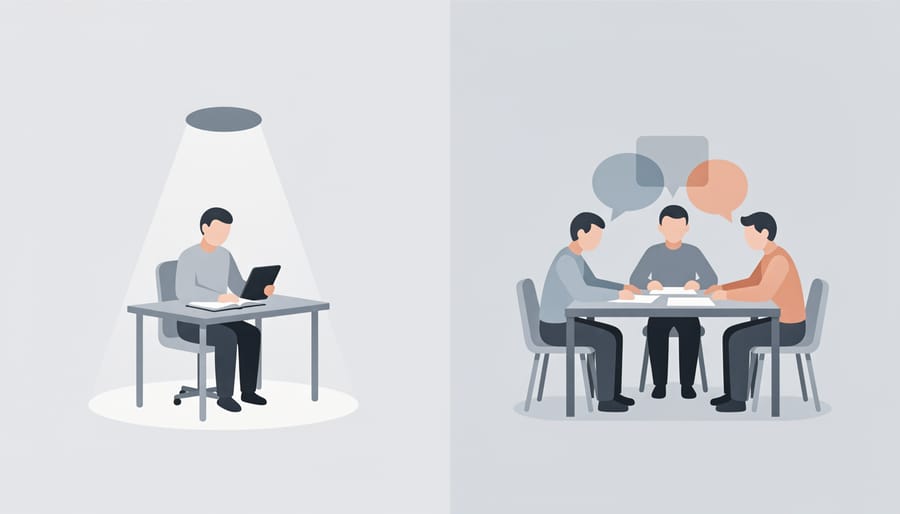
The decision ultimately hinges on whether you prioritize intensive personalization or collaborative practice, and whether your budget supports the premium cost of private instruction. Both formats effectively advance intermediate French skills when matched to the right learner profile.
Who Should Choose Which Format?
Choose One-on-One If You…
You’re a natural fit for one-on-one French 3 instruction if your schedule demands flexibility that group classes can’t accommodate. We’ve found private lessons work exceptionally well for busy professionals who need to reschedule without penalty or squeeze sessions into irregular windows between meetings and travel.
Choose this format when you’re pursuing French for specific professional purposes, preparing for a presentation to Québécois clients, mastering industry terminology for your field, or targeting certification exams with precise scoring requirements. The ability to direct every minute toward your exact objectives proves invaluable when generic curriculum won’t cut it.
If you’ve struggled with particular aspects of French, perhaps conjugating the subjunctive consistently or distinguishing nasal vowels, private instruction lets you address these stumbling blocks without holding back peers or feeling self-conscious. Your teacher adapts explanations and practice until the concept clicks, spending three sessions on pronunciation if that’s what you need.
One-on-one instruction also suits learners working against deadlines: relocating to Montreal in three months, applying for bilingual positions, or preparing for upcoming French-speaking contexts. The accelerated, focused approach maximizes progress when time isn’t on your side.
Finally, if you simply learn better through intensive dialogue and immediate correction rather than observing others, private lessons deliver that concentrated interaction every session.
Choose Semi-Private If You…
Choose semi-private French 3 classes if collaborative learning energizes you and peer interaction enhances your motivation. We’ve found that learners who thrive in small groups typically share certain characteristics that make this format particularly effective for their intermediate French journey.
You’re working within a tighter budget. Semi-private instruction delivers professional teaching and structured curriculum at substantially lower cost than one-on-one lessons, typically reducing your investment by 30-50% while maintaining quality instruction. This makes consistent, long-term learning more financially sustainable.
You enjoy learning alongside others. If you find that friendly classmates push you to prepare more thoroughly, participate more actively, and stay accountable to regular attendance, the small-group dynamic creates natural motivation. Hearing peers wrestle with the same grammar challenges or pronunciation hurdles normalizes the learning process and often sparks helpful discussions.
You value diverse perspectives. Semi-private classes expose you to different accents, vocabulary choices, and cultural viewpoints from fellow learners. This variety mirrors real-world French conversation better than any single instructor-student pairing can, preparing you for the unpredictability of authentic Francophone communication.
Your schedule allows some flexibility. While semi-private classes offer consistent meeting times that work for multiple students, they require slightly more coordination than fully customizable one-on-one sessions. If you can commit to a regular class slot, you’ll benefit from the structured rhythm and peer continuity that builds group cohesion over time.
What Each Option Is
Before we compare how one-on-one and semi-private French 3 classes work in practice, it helps to understand what each format actually means for your learning experience.
One-on-one French 3 instruction pairs you exclusively with a qualified teacher for private lessons. You’re the only student in the session, which means every minute of class time focuses entirely on your needs. Your instructor adapts the curriculum to your specific goals, whether that’s mastering the passé simple, improving conversational fluency for work, or preparing for a proficiency exam. The teacher selects learning materials that match your interests and challenges, and all feedback addresses your individual strengths and areas for growth. Scheduling revolves around your availability, and the pace adjusts to how quickly you grasp new concepts.
Semi-private French 3 instruction brings together a small group of learners, typically two to four students, with a qualified teacher. You share class time with peers who are at a similar intermediate level, creating opportunities for paired practice, group discussions, and collaborative activities. The curriculum follows a structured path suitable for intermediate learners, though instructors still accommodate different learning styles within the group. You benefit from hearing how others work through grammar challenges and pronunciation, while the teacher balances individual attention with group dynamics.
Dimension-by-Dimension Comparison
Choosing between one-on-one and semi-private French 3 classes comes down to what you value most in your learning experience. We’ve compared these formats across the factors that matter for intermediate learners, from how lessons adapt to your needs to what you’ll pay and how quickly you’ll progress.
Personalization sits at the core of the distinction. One-on-one instruction pivots entirely around your specific challenges, whether that’s mastering the subjunctive mood or refining your accent. Your teacher adjusts pace, content, and practice activities based solely on your performance. Semi-private classes offer less customization since the curriculum must serve two to four learners simultaneously, though skilled instructors still address individual questions and tailor some activities to the group’s collective needs.
Speaking practice differs in both quantity and style. Private lessons deliver uninterrupted conversation time with your teacher, every minute of class focuses on your speaking and listening. Semi-private formats split airtime among students, reducing your individual speaking minutes but adding peer dialogue that mimics real-world group conversations. You’ll practice turn-taking, active listening, and responding to different accents and speech patterns.
Cost creates perhaps the clearest trade-off. Semi-private classes typically run 30 to 50 percent less per session than one-on-one instruction, making them more accessible for budget-conscious learners. Private lessons command premium pricing because you’re purchasing exclusive teacher time and fully customized curriculum.
Scheduling flexibility generally favours one-on-one arrangements. You and your teacher coordinate directly, making it easier to accommodate irregular work schedules or last-minute changes. Semi-private classes require aligning multiple calendars, which typically means fixed weekly time slots with less room for adjustment.
Common Questions About French 3 Online Class Formats
Can I switch from semi-private to one-on-one classes if I’m struggling with specific concepts?
Yes, most programs allow format switches between sessions or terms. Many learners start with semi-private instruction and shift to one-on-one when they encounter challenging grammar or pronunciation areas that need focused attention.
Will I progress faster in one-on-one classes compared to semi-private?
Progress speed depends more on your study habits and practice time than format alone. One-on-one classes offer more personalized pacing, but semi-private learners who actively participate and practice outside class often progress just as quickly.
How many students are typically in a semi-private French 3 class?
Most semi-private French 3 classes include two to four students at similar proficiency levels. This small group size ensures everyone receives individual attention while still benefiting from peer interaction and collaborative practice.
Can I combine both formats in my learning plan?
Absolutely. Some learners take semi-private classes for regular practice and schedule occasional one-on-one sessions to address specific challenges like preparing for a presentation or mastering a difficult grammar concept.
How do I know which format matches my learning style?
Consider whether you thrive on collaboration or prefer focused, individualized attention. If you learn well from hearing peers’ questions and enjoy group dynamics, semi-private works beautifully. If you need precise pacing or have specific professional goals, one-on-one instruction typically serves you better.
Are semi-private classes less effective because attention is divided?
Not at all. Quality semi-private instruction balances individual feedback with collaborative learning opportunities that one-on-one formats can’t replicate. You’ll still receive personalized corrections and guidance while gaining the advantage of practicing conversational French with peers at your level.
Beyond these common questions, many learners wonder about trial options before committing to a format. We’ve found that trying a sample lesson in each format helps clarify which environment feels right. Your comfort and engagement matter, the best format is the one where you’ll show up consistently and participate actively.
The transition from French 2 to French 3 brings new linguistic complexity, from subjunctive mood usage to nuanced vocabulary for abstract concepts. Both one-on-one and semi-private formats successfully guide learners through these challenges when matched to individual circumstances. Your schedule constraints, budget, learning preferences, and specific goals all factor into the decision. There’s no universally superior choice, only the format that aligns best with how you learn and what you want to achieve with your French studies.
Making Your Decision
Choosing between one-on-one and semi-private French 3 instruction isn’t about finding the objectively “better” option, it’s about identifying which format aligns with your learning style, goals, and current circumstances. Both pathways offer genuine value for intermediate learners committed to advancing their French proficiency, and we’ve seen students thrive in each setting when the format matches their needs.
Consider what matters most in your French learning journey right now. If you’re balancing professional demands, targeting specific language goals, or working through particular grammar challenges, the tailored attention of private lessons might serve you best. If you enjoy learning alongside others, benefit from hearing different accents and perspectives, and want to build conversational confidence through peer dialogue, a semi-private class could provide the collaborative energy you need.
What matters most is taking the next step. At our organization, we’re committed to supporting your French education through personalized instruction that honors Francophone culture, whether you choose the focused intensity of one-on-one sessions or the dynamic exchange of semi-private learning. Your intermediate French journey deserves an approach designed around you, explore your options and find the format that will help you reach fluency with confidence.