One-on-One vs Semi-Private French Lessons: Which Fits Your Learning Style?

For most French learners in Canada, semi-private programs deliver better value and motivation than one-on-one instruction, particularly if you’re balancing budget with the need for personalized attention and peer interaction. The deciding factor comes down to your learning style and flexibility requirements: if you thrive on social learning and can commit to a fixed schedule, semi-private classes offer 70-80% of the personalization at roughly half the cost, while one-on-one sessions make sense when you need maximum flexibility or have highly specific goals like preparing for a certification exam or mastering industry-specific vocabulary.
Choosing the right program isn’t about finding the objectively best format. It’s about matching your learning preferences, schedule constraints, and budget to the structure that will keep you engaged and progressing. Semi-private programs typically group three to six learners at similar proficiency levels, creating opportunities to practice conversational French in realistic scenarios while still receiving instructor feedback tailored to your weak points. You’ll hear how others tackle the same grammatical challenges, pick up vocabulary from peer discussions, and often form study partnerships that extend beyond class time.
One-on-one instruction gives you complete control over pacing, content focus, and scheduling. Your instructor can pivot instantly when you struggle with a concept, spend extra time on pronunciation quirks specific to your first language, or drill the exact business terminology you need for client presentations. This format shines when your availability changes week to week or when you’re working toward a deadline that doesn’t align with traditional course cycles. The choice ultimately reflects how you learn best and what trade-offs matter most to your French language journey.
At-a-Glance: One-on-One vs Semi-Private French Programs
Before diving into the details, here’s a clear snapshot of how one-on-one and semi-private French programs compare across the factors that matter most to learners:
| Feature | One-on-One Lessons | Semi-Private Lessons |
|---|---|---|
| Pace | Entirely your own speed | Balanced for small group |
| Personalization | 100% customized curriculum | Tailored to shared goals |
| Typical Cost | Higher investment per hour | More budget-friendly |
| Class Size | Just you and instructor | 2-4 students typically |
| Social Learning | Limited peer interaction | Built-in practice partners |
| Scheduling Flexibility | Maximum flexibility | Coordinated with group |
This snapshot reveals the fundamental trade-offs: one-on-one lessons offer complete personalization and control at a premium price, while semi-private programs provide peer interaction and better value with some compromise on individual customization. Your choice depends on which advantages align best with your learning style, budget, and goals.
Understanding Your French Learning Options
What One-on-One French Lessons Look Like
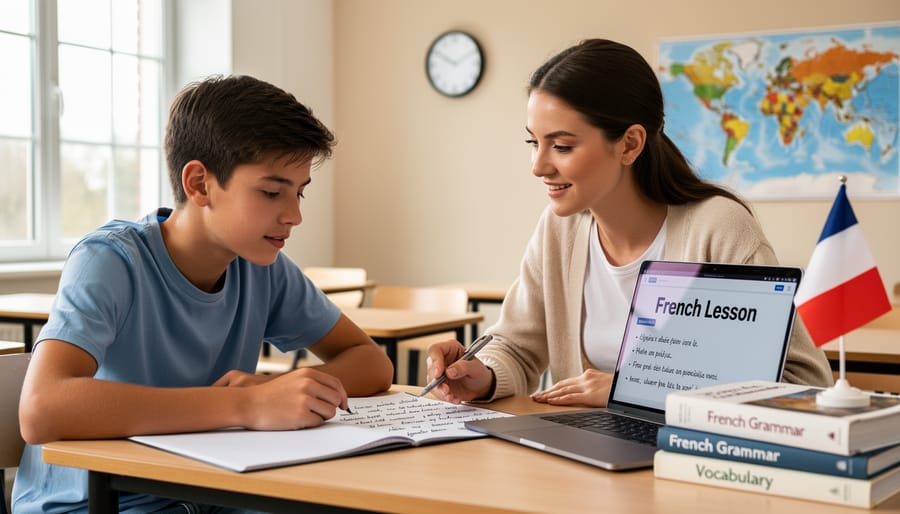
One-on-one French lessons put you in a room (physical or virtual) with a dedicated instructor who focuses entirely on your needs. There’s no dividing attention among multiple students, every minute addresses your specific goals, whether that’s nailing subjunctive conjugations, preparing for a job interview in French, or finally mastering those tricky pronunciation patterns you’ve struggled with.
Your instructor builds a curriculum around you. If you’re a healthcare professional needing medical French vocabulary, your lessons center on that. If you’re preparing for a move to Quebec, sessions emphasize conversational fluency and regional expressions. The instructor adjusts the difficulty level session by session based on how quickly you grasp concepts, slowing down when you need more practice and accelerating through material you pick up easily.
Sessions typically follow your learning style. Visual learners get charts and written exercises, while auditory learners spend more time on listening comprehension and pronunciation drills. Your instructor incorporates interactive tools that match how you learn best, from digital flashcards to role-playing scenarios.
Scheduling flexibility is unmatched. Need to meet at 6am before work? Prefer weekend afternoons? Have an unpredictable calendar that requires last-minute adjustments? One-on-one instruction accommodates your life rather than forcing you into fixed class times. You control the pace, the focus, and even which topics to skip if they’re irrelevant to your goals.
What Semi-Private French Lessons Involve

Semi-private French lessons bring together a small group of learners, usually two to four students, who share similar proficiency levels and learning objectives. Unlike larger classroom settings, these intimate groups allow your instructor to maintain a personalized approach while creating opportunities for peer interaction that simply don’t exist in one-on-one sessions.
Each lesson typically blends structured instruction with collaborative activities. Your teacher introduces new grammar concepts, vocabulary themes, or pronunciation patterns, then guides the group through exercises that put these skills into practice. You might work through role-play scenarios with your classmates, discuss French articles together, or tackle conversation exercises that mimic real-world situations. These peer interactions provide immediate practice opportunities, you’re not just learning from your instructor, but also hearing how others process and use the language.
The curriculum balances common learning goals with individual needs. While everyone works toward shared milestones (mastering past tenses, building business vocabulary, preparing for proficiency exams), skilled instructors adapt explanations and examples to address different learning styles within the group. If one student struggles with verb conjugations while another needs pronunciation help, the teacher can address both through targeted feedback during group activities.
This format creates natural accountability. Seeing classmates progress motivates your own effort, and the friendly environment makes mistakes feel less daunting. You develop confidence through repeated practice with peers who understand exactly what you’re experiencing, all while sharing the learning journey with others invested in mastering French.
Comparing One-on-One and Semi-Private Programs Across Key Dimensions
Personalization and Pace
One-on-one lessons offer unmatched personalization. Your instructor designs every activity around your specific goals, whether you’re preparing for a business presentation, planning a move to Quebec, or targeting specific grammar challenges. You control the pace entirely, spending three sessions on subjunctive mood if needed, or racing through material you grasp quickly. The curriculum adapts in real time based on your performance and interests, incorporating relevant French learning materials that match your exact proficiency level and professional field.
Semi-private programs balance personalization with group dynamics. While the curriculum follows a structured path that addresses common learning objectives, instructors still accommodate individual needs within the small group setting. You’ll move at a pace that works for 2-4 people rather than just you, which can actually benefit learners who might rush or linger too long without peer influence. The shared environment means you won’t deep-dive into highly specialized content, but you gain from collaborative activities and varied perspectives that reinforce concepts differently than solo instruction.
The key trade-off: one-on-one maximizes customization and control, while semi-private provides structured progression with built-in practice partners. Your decision hinges on whether you value complete flexibility or productive peer interaction.
Cost and Value Considerations
The most visible difference between formats is cost: one-on-one lessons typically run $50, $80 per hour, while semi-private sessions cost $25, $40 per person. That price gap reflects the resource allocation, you’re paying for undivided instructor time versus shared expertise, but the value equation extends beyond the hourly rate.
One-on-one lessons deliver concentrated progress. Every minute addresses your specific needs, eliminating time spent on concepts you’ve already mastered or waiting for classmates to catch up. If you need conversational French for a job interview in three months, that efficiency justifies the premium. You’re buying speed and precision.
Semi-private programs stretch your budget further while adding peer interaction that enhances retention. Hearing classmates make mistakes you might make, practicing dialogues with real partners, and benefiting from questions you hadn’t thought to ask all contribute value that solitary study can’t replicate. For learners without urgent deadlines, this format offers strong return on investment, and it’s more accessible than options to learn French for free which often lack structured feedback.
Calculate value by dividing your goals by your timeline and budget. Faster timelines favor one-on-one; tighter budgets benefit from semi-private’s collaborative advantages.
Social Learning and Practice Opportunities
Semi-private lessons create natural opportunities for conversation practice that mirror real-world French usage. When you learn alongside peers, every class becomes a mini-dialogue session where speaking fosters interaction and builds fluency through spontaneous exchanges. You’ll practice asking questions, responding to different speaking styles, and navigating conversational turns, skills that solo study can’t replicate.
The peer dynamic also accelerates confidence building. Hearing classmates make mistakes and recover gracefully normalizes the learning process. You discover that everyone stumbles over conjugations, and this shared experience reduces performance anxiety. When your conversation partner uses an expression you haven’t encountered, you learn it in context, making it stick better than vocabulary drills alone.
One-on-one lessons offer focused correction and personalized feedback but lack this collaborative element. You won’t practice the give-and-take of group discussion or learn how different speakers interpret the same phrase. For cultural immersion, semi-private settings expose you to diverse perspectives on Francophone culture as classmates share their own interpretations and experiences. This social dimension transforms language acquisition from an academic exercise into genuine communication practice.
Scheduling Flexibility and Commitment
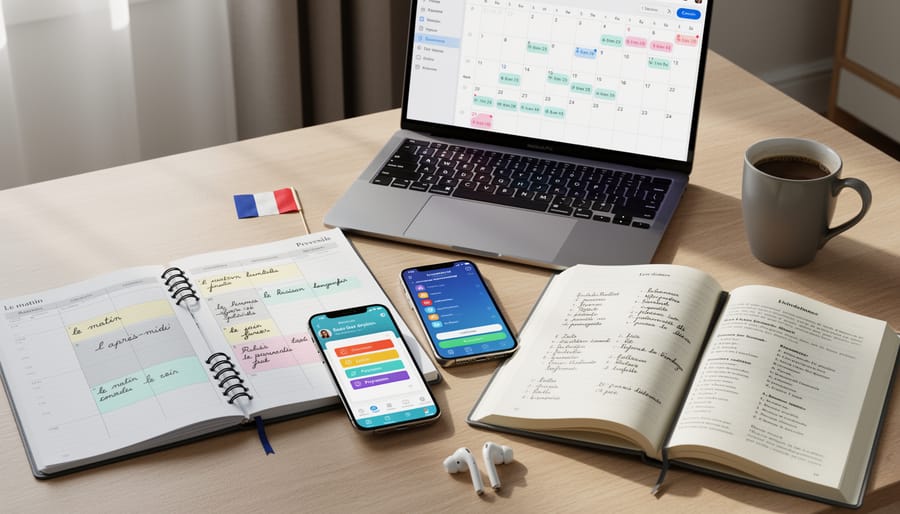
One-on-one lessons typically offer superior scheduling flexibility. You coordinate directly with your instructor to find times that work for both of you, making it easier to accommodate irregular work schedules, travel, or family commitments. Need to reschedule? A quick conversation with your teacher usually resolves it. You can also adjust session frequency, weekly during busy periods, twice weekly when you have more time, without disrupting a group’s rhythm.
Semi-private programs require coordinating multiple schedules, which naturally reduces flexibility. Once your small group establishes a regular meeting time, changing it means consulting everyone involved. This creates built-in accountability (you can’t easily skip without letting classmates down), but less room for spontaneous adjustments. Most semi-private programs follow a consistent schedule, say, every Tuesday and Thursday evening, which works beautifully if you have predictable availability but can feel restrictive if your calendar fluctuates.
The commitment level differs too. One-on-one students sometimes struggle with self-discipline since rescheduling feels consequence-free. Semi-private learners benefit from peer accountability, the knowledge that others are counting on you creates stronger attendance habits. Consider whether you need external structure to stay committed or prefer managing your own learning timeline.
Accountability and Motivation
In one-on-one lessons, accountability comes from your instructor’s direct observation of your progress. There’s nowhere to hide, your teacher knows exactly where you excel and where you struggle, which creates natural pressure to complete homework and show up prepared. This format works brilliantly if you’re self-motivated and respond well to personalized expectations. However, some students find the constant spotlight intimidating or miss the external push that comes from peers.
Semi-private lessons introduce a different motivational dynamic. When you’re learning alongside others, you naturally benchmark your progress, which can spur you to practice more between sessions. There’s gentle competition, not in a stressful way, but in the “I want to keep up” sense that drives many learners. You’re also less likely to cancel or skip practice because you know your classmates are counting on you to show up. This peer accountability resonates particularly with social learners who draw energy from group settings and enjoy collaborative progress.
Consider whether you’re more motivated by direct teacher feedback and individual goal-tracking, or by the momentum and camaraderie of learning with others progressing alongside you.
Who Should Choose Which Format

One-on-One Is Your Best Choice If…
Private lessons deliver unmatched value when your situation demands complete customization or maximum flexibility. If you’re preparing for a job interview in three weeks, relocating to Quebec next month, or facing an imminent certification exam, one-on-one instruction lets you compress timelines and focus exclusively on what you need most. Your teacher builds every session around your deadline, skipping topics that don’t serve your immediate goal.
Professionals pursuing advanced fluency for specialized fields, legal terminology for courtroom work, medical vocabulary for healthcare settings, technical language for engineering projects, benefit enormously from private lessons. You can dedicate entire sessions to industry-specific scenarios, refine precise terminology, and practice authentic workplace interactions without waiting for group curriculum to catch up.
Choose one-on-one if your schedule is genuinely unpredictable. Flight attendants, shift workers, parents with changing childcare arrangements, and anyone juggling irregular commitments find private lessons accommodate last-minute rescheduling and odd-hour availability that group formats simply can’t match.
Privacy matters too. Some learners feel self-conscious practicing pronunciation, making mistakes, or discussing personal topics in front of others. If you’re naturally introverted, recovering from negative past classroom experiences, or just prefer undivided attention without peer observation, private instruction creates a judgment-free space where you can take risks and ask questions freely.
Finally, if you’re addressing specific weaknesses, persistent grammar struggles, pronunciation challenges, or gaps from interrupted learning, targeted private coaching isolates and resolves those issues faster than any shared curriculum could.
Semi-Private Makes More Sense When…
Semi-private lessons shine when your French learning journey benefits from shared experiences and collaborative energy. If you’re learning alongside a friend, family member, or colleague who shares similar goals and proficiency levels, semi-private formats let you progress together while splitting costs, creating accountability partners who understand exactly what you’re working through each week.
Budget-conscious learners find exceptional value here. You’ll receive professional instruction and structured curriculum at roughly half the cost of one-on-one sessions, making consistent, long-term language study financially sustainable. The savings add up quickly over months of regular lessons, letting you invest in more frequent sessions or extend your learning timeline without financial strain.
Conversation practice seekers thrive in semi-private settings. You get built-in speaking partners at varied proficiency levels, forcing you beyond memorized scripts into genuine dialogue. The natural back-and-forth that develops when multiple learners discuss a topic in French mirrors real-world conversations far better than solo instruction can replicate.
Social learners who draw energy from group dynamics appreciate the collaborative atmosphere. Shared challenges create camaraderie, you’ll laugh together over pronunciation mishaps, celebrate each other’s breakthroughs, and develop friendships rooted in mutual language goals. The gentle peer pressure keeps you motivated between sessions, while diverse perspectives during discussions expose you to different ways of thinking in French. If isolation drains your motivation but supportive community energizes your efforts, semi-private lessons provide the social framework that sustains long-term commitment.
Can You Switch Between Formats?
You’re not locked into one format forever. Most French learning programs, including the French Educational Organisation, let you switch between one-on-one and semi-private lessons as your needs change. You might start with private sessions to build confidence, then transition to semi-private for conversation practice. Some learners alternate formats seasonally, taking group lessons during relaxed periods and switching to private tutoring when work demands flexibility. You can even combine both simultaneously, using one-on-one for grammar mastery and semi-private for speaking fluency.
Making Your Decision: Key Questions to Ask Yourself
Before committing to either format, walk through these essential questions. Your honest answers will point you toward the learning structure that matches your real-world situation and preferences.
Start by examining your learning preferences and practical constraints:
- Do I focus better with undivided attention, or do I thrive on peer interaction and collaborative activities?
- What’s my realistic monthly budget for French lessons, and how many hours of instruction does that afford in each format?
- How predictable is my schedule, and do I need the ability to reschedule sessions frequently?
- Am I working toward a specific deadline (job interview, exam, relocation) or learning at a comfortable long-term pace?
- Do I have highly specialized needs (industry-specific vocabulary, presentation skills) or more general conversation goals?
- Would I feel energized or self-conscious practicing French in front of other learners?
- Do I learn best through structured repetition and explanation, or through spontaneous conversation and real-time correction?
- Is cost my primary concern, or am I willing to invest more for maximum efficiency and personalization?
Write down your responses. If you lean toward privacy, customization, and have specific professional needs with flexible funds, one-on-one lessons likely suit you better. If you value cost efficiency, enjoy learning alongside others, and want built-in conversation practice, semi-private offers compelling advantages.
There’s no trick to this decision. The format that aligns with how you actually live, learn, and budget will produce better results than the option that looks ideal on paper but doesn’t fit your reality. Trust your self-knowledge here.
Frequently Asked Questions
How much more expensive are one-on-one lessons compared to semi-private?
One-on-one French lessons typically cost 40-60% more per hour than semi-private sessions. However, the increased personalization often means faster progress, which can offset the higher hourly rate over time.
Will I learn faster in one-on-one or semi-private lessons?
Learning speed depends more on your personal engagement and practice habits than the format itself. One-on-one allows you to move through material at exactly your pace, while semi-private provides valuable conversation practice that accelerates speaking confidence.
Can I try both formats before committing to one?
Absolutely. Most programs allow you to experience a trial session in each format, and many learners successfully alternate between the two depending on what skills they’re working on at different stages.
What’s the minimum commitment required for each format?
This varies by provider, but semi-private classes often require a longer initial commitment (such as an 8-week term) to maintain group continuity, while one-on-one lessons may be available with more flexible week-to-week scheduling.
How are students matched in semi-private groups?
Quality programs group students by proficiency level and learning goals to ensure everyone benefits from similar-paced instruction. You’ll typically be matched with learners who share your approximate skill level and objectives.
Is one format better for complete beginners?
Both work well for beginners. Semi-private lessons help new learners realize they’re not alone in making mistakes and build confidence through peer interaction, while one-on-one provides a safe space to ask unlimited questions without self-consciousness.
These questions reflect what learners genuinely wrestle with when comparing their options. Beyond the practical concerns about money and time, many people wonder whether their choice will actually affect their success. The truth is that your commitment level and the quality of instruction matter far more than the format itself.
If you’re still uncertain after reviewing these answers, consider what makes you uncomfortable about each option. Does the thought of practicing pronunciation in front of others make you anxious? One-on-one removes that pressure entirely. Conversely, if the idea of being the instructor’s sole focus for an entire hour feels intense, the shared attention in semi-private might suit you better. Your gut reaction to these scenarios often reveals which environment will keep you motivated and engaged, which ultimately determines how much French you’ll actually learn.
Neither one-on-one nor semi-private French lessons is inherently better. The right choice depends entirely on who you are as a learner. Some students flourish with the undivided attention and customized pace of private instruction, while others gain confidence and momentum from the collaborative energy of small-group learning. Your personal circumstances, whether they’re budget constraints, scheduling demands, or specific language goals, matter more than any blanket recommendation.
The French Educational Organisation designed both formats with the same commitment to excellence and cultural immersion. Whether you’re working privately with an instructor or learning alongside fellow francophones-in-training, you’ll experience the same dedication to personalized education and authentic connection to Francophone culture. Many students discover their ideal path involves both formats at different stages of their journey.
Take time to honestly assess what you need right now. Reflect on the questions throughout this guide, consider your current life situation, and remember that your choice isn’t permanent. The most important step is simply starting your French learning journey with the format that feels right today. Both paths lead to the same rewarding destination: confident, fluent French communication.