Why Advanced French Fluency Opens Doors Most Canadians Never Knew Existed

Mastering advanced French means moving beyond textbook accuracy to embrace the nuance, spontaneity, and cultural depth that native speakers navigate effortlessly. At this level, you’re not just translating thoughts from English—you’re thinking, debating, and even dreaming in French. You understand the subtle difference between “je suis désolé” and “je m’excuse,” catch the humor in wordplay, and recognize regional expressions from Québec to Acadie. This proficiency opens doors across Canada, where bilingualism remains a competitive advantage in government, healthcare, education, and international business sectors.
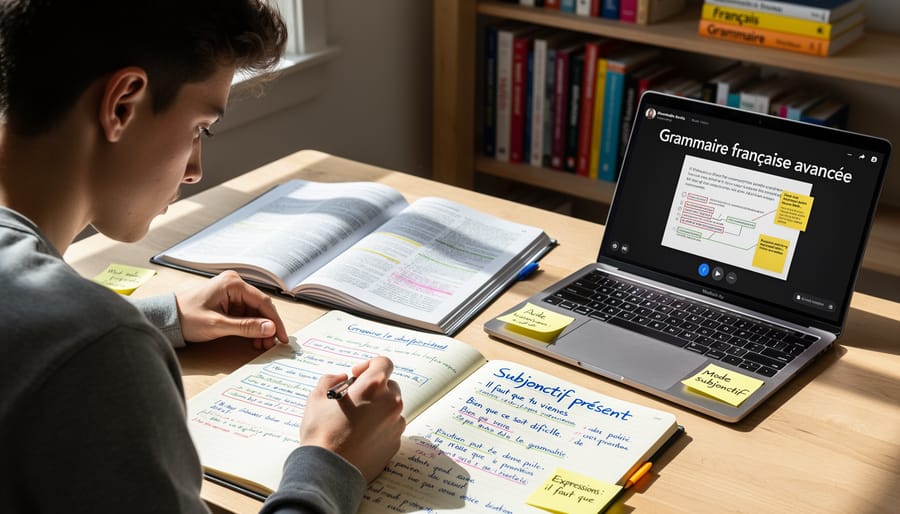
Reaching advanced proficiency requires deliberate practice that targets your remaining gaps. Immerse yourself in complex French media—podcasts discussing philosophy, novels by contemporary Francophone authors, or news analysis from Radio-Canada—to internalize sophisticated vocabulary and sentence structures. Engage in debates or discussions with native speakers about abstract topics like ethics, politics, or art, pushing yourself to articulate nuanced positions without defaulting to English. Study the mechanics of style by analyzing how French writers use the subjunctive mood for doubt, the conditional for diplomacy, and various registers for different audiences.
The journey from intermediate competence to advanced mastery feels daunting because progress becomes less visible. You’re no longer learning obvious grammar rules but refining subtleties—appropriate register, idiomatic precision, cultural references. Personalized instruction accelerates this stage dramatically because a skilled teacher identifies your specific blind spots, whether that’s mastering “en” and “y” pronouns, eliminating anglicisms, or developing confidence in professional contexts.
Advanced French proficiency isn’t perfection—it’s the ability to communicate effectively and authentically across contexts while appreciating the richness of Francophone culture. The investment transforms not just your language skills but your connection to Canada’s bilingual identity.
What Actually Defines Advanced French Language Skills
So what exactly makes someone an advanced French speaker? If you’ve been learning French for a while, you might wonder where you stand and what separates confident intermediate learners from those who’ve truly reached advanced proficiency. The good news is that advanced French isn’t about perfection—it’s about capability, nuance, and the confidence to navigate complex situations entirely in French.
The CEFR proficiency levels provide a helpful framework for understanding where you are in your language journey. While intermediate learners (B1) can handle everyday conversations and familiar topics, advanced learners move into territory where French becomes a tool for sophisticated expression and cultural connection.
- B2 (Upper Intermediate)
- You can discuss complex topics like Canadian environmental policy or debate the merits of different healthcare approaches, understanding the main ideas even when conversations move quickly. Think of confidently participating in a Montreal office meeting or following a Radio-Canada news broadcast without subtitles.
- C1 (Advanced)
- You express yourself fluently and spontaneously, grasping implicit meanings and cultural references in Québécois films or francophone literature. At this level, you could write a professional report, deliver a presentation at a bilingual conference, or engage in nuanced discussions about abstract concepts like identity or social justice.
- C2 (Mastery)
- You understand virtually everything you hear or read with ease, including regional expressions from Acadian communities or specialized terminology. This level means distinguishing subtle shades of meaning and expressing yourself with precision that rivals educated native speakers.
Beyond these formal classifications, advanced French skills reveal themselves in practical ways. You can switch registers effortlessly—from casual conversations with friends at a café to formal presentations in professional settings. You understand cultural nuances, recognizing when someone is being polite versus genuinely enthusiastic, or catching the humour in a well-placed Quebec expression like “c’est tiguidou.”
Advanced learners also demonstrate linguistic flexibility. You can paraphrase when you don’t know a specific word, understand jokes and wordplay, and follow rapid-fire conversations among native speakers without feeling lost. Perhaps most importantly, you think in French rather than translating from English, allowing for natural, spontaneous communication.
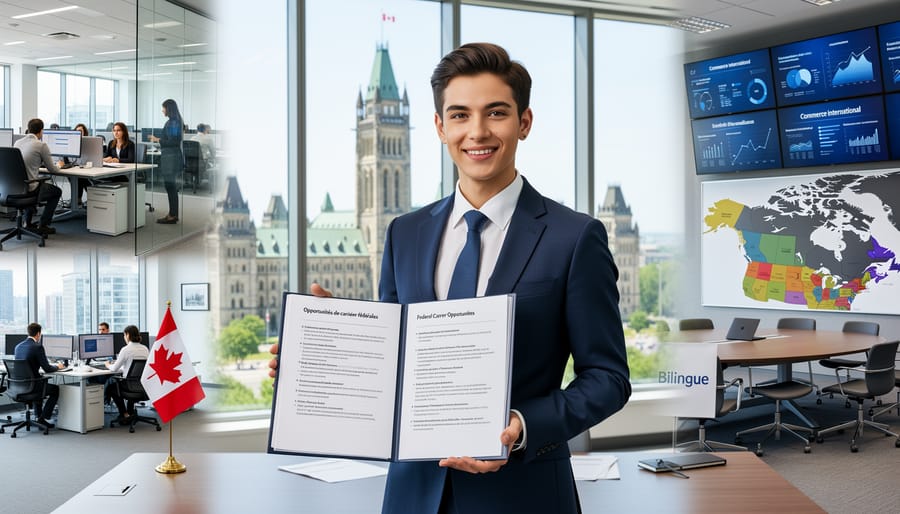
For Canadians, reaching advanced French proficiency opens doors—from career opportunities in federal positions to deeper connections with francophone communities across the country. The journey requires dedication, but understanding these milestones helps you recognize how far you’ve come and chart your path forward with clarity and purpose.

The Four Pillars of Advanced French Mastery
Complex Grammar Structures That Sound Natural
At the advanced level, you’ll want these complex structures to flow naturally in conversation, not just exist as textbook rules. The subjunctive mood, for instance, appears constantly in everyday French—after expressions of emotion, doubt, or necessity. Rather than memorizing triggers, focus on recognizing patterns through authentic French media and conversations. Listen for phrases like “bien que” or “il faut que” in Francophone Canadian podcasts to hear how natives weave subjunctive effortlessly into speech.
Conditional tenses become second nature when you practice them in realistic scenarios. Think about how you’d express hypothetical situations in your daily life: planning a trip to Quebec City, discussing career possibilities, or imagining different outcomes. The key is context over conjugation charts.
Passive constructions and pronoun placement often trip up learners because the rules feel rigid. Instead of overthinking placement, immerse yourself in written French—newspapers from Montreal or Radio-Canada articles—where these structures appear naturally. Notice how pronouns dance around verbs in everyday sentences.
The goal isn’t perfection; it’s developing an intuitive feel for what sounds right. Working with a personalized tutor helps tremendously here, as they can catch your patterns and guide you toward more natural phrasing through real conversation practice.
Vocabulary That Goes Beyond the Dictionary
Mastering advanced French means going well beyond textbook vocabulary to embrace the living, breathing language as it’s actually spoken. Idiomatic expressions like “casser les pieds” (to annoy someone) or “avoir le cafard” (to feel down) add colour and authenticity to your conversations. Understanding these phrases helps you connect more naturally with native speakers.
In Canada, you’ll encounter fascinating regional variations between Québécois and European French. Québécois French features distinctive vocabulary—”char” instead of “voiture” for car, or “dépanneur” for convenience store—and unique expressions that reflect the province’s cultural identity. Embracing these differences enriches your appreciation of Francophone culture across different communities.
Professional contexts demand specialized terminology depending on your field, whether that’s medical French, legal language, or business communications. Advanced learners also develop the subtle skill of choosing between synonyms based on register and context. Understanding when “demeure” sounds more formal than “maison” or recognizing that “bosser” is casual while “travailler” works everywhere demonstrates true linguistic sophistication. This nuanced vocabulary selection transforms competent speakers into confident, culturally aware communicators who can navigate any French-speaking environment with ease.
Pronunciation and Accent Refinement
Refining your pronunciation at the advanced level means mastering the nuances that make French flow naturally. Focus on liaison, where final consonants connect smoothly to following vowels (les amis becomes “lez-amis”), and elision, where certain vowels disappear before others (je aime becomes j’aime). These aren’t just rules—they’re the rhythm of authentic French conversation.
Intonation patterns also matter significantly. French sentences tend to rise gradually before falling at the end, quite different from English’s varied pitch. Listening to Francophone media from Quebec and other Canadian French communities helps you internalize these melodic patterns naturally.
If you’re working to reduce an anglophone accent, remember that clarity matters more than perfection. Many successful bilingual Canadians speak with a slight accent while communicating effectively in professional settings. A personalized learning approach lets you identify which pronunciation challenges affect your comprehensibility most, allowing you to prioritize improvements that make the biggest difference in real conversations. Embrace the learning process—your unique voice enriches Canada’s diverse Francophone landscape.
Cultural Fluency and Social Intelligence
Mastering advanced French goes beyond grammar rules and vocabulary—it’s about understanding the cultural nuances that bring conversations to life. When you catch a reference to Astérix or La Grande Noirceur, respond appropriately to “tu” versus “vous” in social contexts, or recognize the playful wordplay in Quebec expressions like “ça coûte la peau des fesses,” you’re demonstrating true cultural fluency.
This social intelligence transforms your French from technically correct to genuinely engaging. It means understanding when directness is appreciated versus when diplomacy matters, recognizing regional differences between Parisian and Quebecois communication styles, and picking up on the subtle humor woven through everyday exchanges. These skills help you navigate professional networking events, connect authentically with Francophone colleagues, and feel confident in social settings.
Developing this cultural awareness happens naturally through immersion—watching films, reading contemporary literature, and most importantly, having meaningful conversations with native speakers who can share context and explain the “why” behind cultural practices. Personalized learning experiences accelerate this journey by focusing on the specific cultural contexts most relevant to your Canadian experience.
Why Advanced French Matters for Canadians Specifically
In Canada’s unique bilingual landscape, intermediate French skills might help you navigate everyday conversations, but advanced proficiency opens doors that remain firmly closed to those who haven’t pushed beyond the basics. Understanding the nuances of subjunctive mood, mastering professional correspondence, and confidently participating in complex discussions aren’t just nice-to-have skills—they’re increasingly essential for anyone serious about maximizing their opportunities in this country.
The reality is that many Canadians reach an intermediate plateau and assume that’s sufficient. After all, you can order at a restaurant in Montreal, chat with colleagues, and understand French radio, right? But here’s what intermediate often can’t do: it won’t qualify you for most federal government positions requiring bilingual designation, it won’t let you effectively negotiate contracts with Francophone clients, and it typically won’t enable you to appreciate the subtleties of Francophone literature, film, or humour that make Canada’s French culture so vibrant.
Advanced French proficiency creates tangible career advantages across multiple sectors:
- Federal government positions with CBC/BBB/CCC language profiles that command higher salaries and promotion opportunities
- Provincial roles in Quebec, New Brunswick, and bilingual services across other provinces
- Corporate positions in companies doing business in France, West Africa, or other Francophone markets
- Education and academic research roles requiring publication and presentation in French
- Translation, interpretation, and language instruction careers
- Healthcare, legal, and social services positions serving Francophone communities
Beyond career considerations, advanced French allows you to truly participate in Canada’s Francophone cultural life. You’ll catch the wordplay in Acadian theatre, understand the historical references in Quebec cinema, and engage meaningfully with Francophone friends and communities. This isn’t about perfect grammar for its own sake—it’s about connection, opportunity, and fully experiencing everything Canada offers.
The investment in moving from intermediate to advanced French proficiency typically takes dedicated effort over one to two years, but the returns—both professional and personal—compound throughout your life. Whether you’re aiming for a specific career goal or simply want to bridge the gap between understanding French and truly living it, advancing beyond intermediate isn’t just ambitious, it’s practical. In a country where French isn’t just studied but lived by millions, advanced proficiency transforms you from an observer of Francophone Canada into an active participant.
How Personalized Learning Accelerates Your Advanced Journey
At the advanced level, generic group classes often miss the mark. You’ve already mastered the fundamentals, so sitting through lessons that review material you’ve conquered or follow topics that don’t align with your specific interests can feel frustrating and unproductive. This is precisely why personalized learning becomes essential as you refine your French abilities.
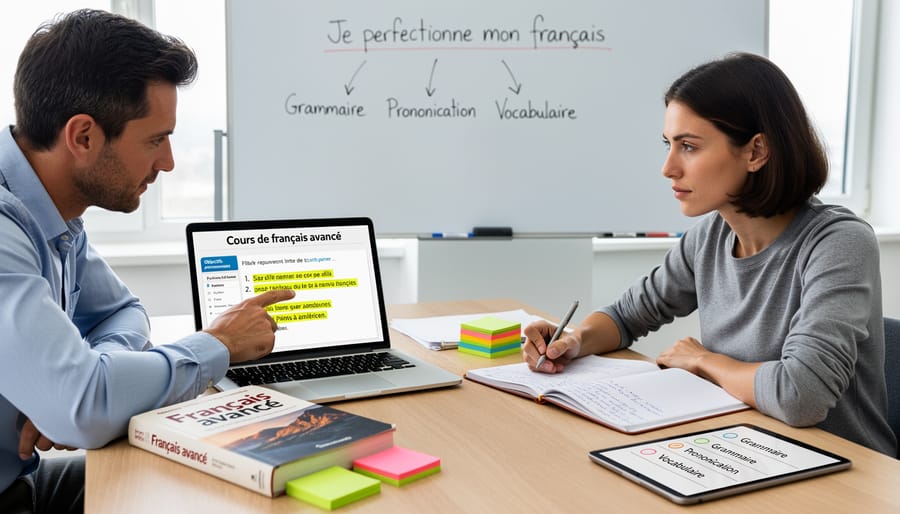
When you work one-on-one with an instructor, every minute of your learning time targets your unique needs. Perhaps you’re comfortable with conversational French but struggle with the subjunctive mood in complex sentences. Maybe you need to master the nuanced vocabulary of your professional field, whether that’s legal terminology, medical French, or business expressions. A personalized approach means your instructor can identify these gaps during your very first session and build a curriculum around closing them.
Group classes at advanced levels often move at a pace determined by the slowest learner, which means you might spend weeks on concepts you grasp in minutes. With customized instruction, you accelerate through areas where you’re strong and dedicate more time to aspects that challenge you. This efficiency matters tremendously when you’re balancing language learning with work, family, and other commitments.
Your interests also play a crucial role in maintaining motivation at this stage. If you’re passionate about Quebec literature, your lessons can incorporate works by Gabrielle Roy or Michel Tremblay. If you’re preparing for a career opportunity in Montreal or Ottawa, your instructor can simulate job interviews and workplace scenarios specific to your industry. This relevance keeps learning engaging rather than feeling like an obligation.
Furthermore, personalized learning adapts to your goals. Some advanced learners aim for near-native fluency to fully integrate into Francophone communities, while others need specialized skills for specific contexts. A one-size-fits-all curriculum cannot address this diversity. Your instructor becomes a partner in your journey, adjusting strategies based on your progress and feedback.
The result is a learning experience that respects your investment of time and energy. Instead of wondering if you’re in the right class, you can focus entirely on growth, knowing each lesson brings you measurably closer to the sophisticated command of French you’re working toward.
Practical Strategies to Reach Advanced Proficiency
Reaching advanced proficiency in French requires more than passive study—it demands strategic, intentional practice that pushes you beyond your comfort zone. The good news? You can design an effective learning approach that fits your lifestyle and goals, whether you’re working with a tutor or studying independently.
The foundation of advanced learning lies in authentic engagement with the language as native speakers actually use it. This means moving beyond textbook exercises and immersing yourself in genuine French content. Listen to francophone podcasts from Radio-Canada or France Culture, watch films from Québec and France without subtitles, and read contemporary French literature or newspapers like Le Devoir or Le Monde. These materials expose you to natural speech patterns, regional variations, and cultural references that textbooks simply can’t replicate.
To structure your learning journey effectively, consider following this progression:
- Assess your current level honestly by identifying specific gaps in your grammar, vocabulary, or comprehension. Recording yourself speaking or writing can reveal patterns you need to address.
- Set targeted goals for each skill area. Rather than vague aims like “get better at French,” focus on measurable objectives such as “hold a 30-minute conversation about politics” or “write a persuasive essay.”
- Create a daily immersion routine that incorporates varied activities. Spend mornings reading French news, afternoons listening to podcasts during your commute, and evenings practicing conversation or writing.
- Engage with native speakers regularly through language exchange meetups, online conversation partners, or immersion opportunities in francophone communities across Canada.
- Review and adjust your approach monthly, celebrating progress while identifying new areas to tackle.
Deliberate practice makes the difference at advanced levels. This means actively challenging yourself rather than sticking with comfortable topics. If business French feels difficult, that’s exactly where you should focus your energy. Try shadowing technique—repeating what you hear immediately after native speakers—to improve pronunciation and fluency. Write regularly in French, whether through journaling, blog posts, or essays, then seek feedback from native speakers or qualified instructors.
Don’t underestimate the power of specialized vocabulary building. Advanced learners benefit from diving deep into specific domains like law, medicine, technology, or arts—areas relevant to your professional or personal interests. Create thematic vocabulary lists and use them in context through writing or conversation practice.
Personalized learning experiences accelerate progress significantly. Working one-on-one with an experienced instructor allows you to receive immediate feedback, address fossilized errors, and explore topics that genuinely interest you. A skilled teacher can also introduce you to aspects of francophone culture—from Québécois expressions to French-Canadian history—that enrich your understanding beyond language mechanics.
Remember, reaching advanced proficiency is a marathon, not a sprint. Consistency matters more than intensity, so build sustainable habits that keep you engaged with French every single day.
Reaching an advanced level in French is undoubtedly challenging, but it’s absolutely within your reach with dedication and the right approach. Throughout your journey, you’ve likely discovered that language learning isn’t just about memorizing vocabulary or mastering verb conjugations—it’s about opening doors to new perspectives, connections, and opportunities. The cultural richness of la francophonie awaits you, from the vibrant streets of Montreal to the literary works of Gabrielle Roy, from engaging conversations with colleagues to fully appreciating French-Canadian cinema without subtitles.
The path to advanced proficiency requires patience and consistent effort, but you don’t have to navigate it alone. Personalized learning experiences make all the difference when you’re working at this level. Unlike generic courses that move at a predetermined pace, individualized instruction adapts to your specific goals—whether you’re preparing for professional certification, refining your accent, or exploring specialized vocabulary in your field. A supportive learning partner who understands your unique strengths and challenges can help you break through plateaus and maintain momentum when the journey feels demanding.
Remember that every francophone you admire was once where you are now, facing the same uncertainties and celebrating similar breakthroughs. The practical benefits of advanced French proficiency in Canada—enhanced career prospects, deeper cultural connections, and the simple joy of expressing yourself fluently in both official languages—make every hour of practice worthwhile.
If you’re ready to take the next step in your French journey, consider exploring personalized learning options designed specifically for Canadian learners like you. With the right support and your commitment, advanced French fluency isn’t just a distant goal—it’s your next achievement.